You Won’t Believe These Hidden Gems in Dijon’s Historic Streets
When you think of Dijon, France, mustard might come to mind first—but this Burgundian capital holds far deeper charms. Beyond the crowded squares and tourist shops, its lesser-known landmark buildings whisper stories of medieval guilds, Renaissance artisans, and centuries-old craftsmanship. I wandered off the main paths and discovered architectural wonders few travelers ever see. Let me take you where guidebooks don’t—into the heart of Dijon’s authentic, quiet grandeur.
Reimagining Dijon: More Than Just a Mustard Stop
Dijon is often reduced to a single flavor: sharp, golden mustard served in iconic ceramic jars. While the condiment remains a beloved symbol of the city, it barely scratches the surface of Dijon’s rich historical and architectural legacy. As the former capital of the powerful Dukes of Burgundy, Dijon was once a political and cultural epicenter of medieval Europe. Its streets were paved with ambition, artistry, and influence that extended far beyond regional borders. Yet today, many visitors pass through with only a brief stop at a mustard shop, missing the city’s true essence hidden in plain sight.
Exploring beyond the postcard-perfect Place de la Libération or the bustling market stalls allows travelers to engage with Dijon on a deeper level. The city’s quieter corners reveal centuries of urban evolution, where Gothic spires rise beside Renaissance façades and iron-laced arcades shelter daily life. These overlooked spaces are not just relics—they are living parts of a city that values continuity over spectacle. By stepping away from the mainstream, one begins to appreciate how history in Dijon isn’t performed for tourists; it’s simply lived.
There is a growing movement in travel toward authenticity and meaningful connection. Rather than chasing checklists, modern explorers seek moments of resonance—places that evoke emotion, reflection, and a sense of discovery. Dijon, with its understated elegance and layered past, offers exactly that. The reward for venturing beyond the obvious is not just rare photographs or bragging rights, but a more intimate understanding of how cities preserve identity through time. This journey into Dijon’s hidden landmarks is not about rejecting the popular; it’s about expanding one’s vision to include what lies just out of frame.
The Forgotten Gates: Traces of Medieval Walls
Long before Dijon became synonymous with fine wine and gourmet fare, it was a fortified stronghold guarding the eastern frontier of the Duchy of Burgundy. Though little remains of its once-imposing defensive walls, fragments still linger throughout the city, quietly embedded in the urban fabric. These remnants offer a tangible link to Dijon’s medieval past, when security, power, and civic pride were etched into stone and mortar. One of the most striking survivors is the Tour Philippe le Bon, a massive circular tower that once formed part of the city’s outer ramparts.
Rising over 46 meters high, the tower was constructed in the 15th century under Duke Philip the Good, a ruler known for his patronage of the arts and military strategy. From its summit, guards once scanned the horizon for approaching threats, while the ducal court flourished below. Today, visitors can climb the spiral staircase to enjoy panoramic views of Dijon’s rooftops, slate-gray and terracotta, stretching toward the rolling hills of Burgundy. The contrast between past vigilance and present tranquility is palpable.
Elsewhere, sections of the old curtain walls have been absorbed into later buildings, their weathered stones visible behind modern shopfronts or within private courtyards. Near Rue des Forges, a stretch of medieval masonry peeks out from beneath ivy, nearly unnoticed by passersby. These fragments are not always marked or promoted, yet they carry the weight of centuries. Their obscurity is precisely what makes them powerful—these are not museum pieces under glass, but enduring parts of everyday life.
Why are these structures so rarely highlighted in tourism materials? Partly because they do not conform to the polished, picture-ready image often marketed to travelers. Unlike grand cathedrals or manicured plazas, these remnants are subtle, fragmented, and sometimes difficult to access. Yet their quiet presence speaks volumes about resilience and continuity. For those willing to look closely, Dijon’s medieval gates and towers become silent guides to a world long gone—but never fully erased.
Courtyards of Silence: Hidden Hôtels Particuliers
Scattered throughout Dijon’s old town are hidden architectural treasures known as hôtels particuliers—private mansions built by noble families, magistrates, and wealthy merchants between the 15th and 18th centuries. These residences were designed not only for comfort but as statements of status, their ornate façades adorned with carved stone, intricate ironwork, and symmetrical courtyards. While many remain privately owned or repurposed for administrative use, several are accessible to the public, offering glimpses into a refined, almost secretive world of aristocratic life.
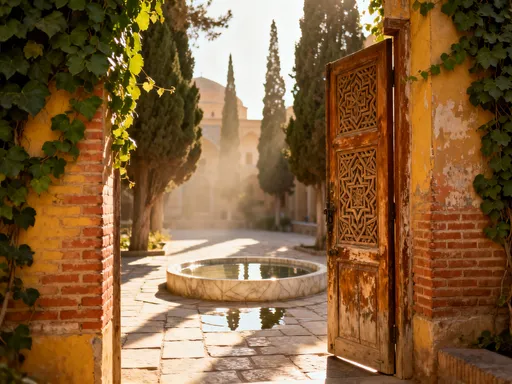
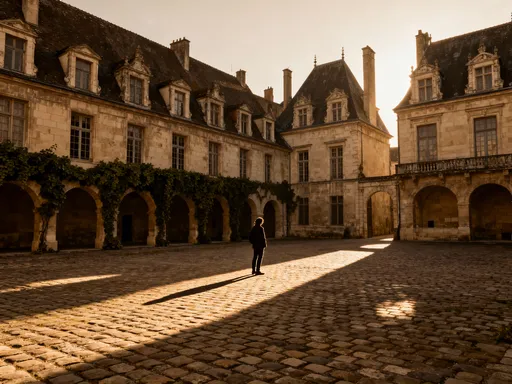
One of the most elegant examples is the Hôtel de Vogüé, located just off Rue Sainte-Anne. Though now housing government offices, its courtyard remains open during daylight hours, inviting quiet contemplation. Stepping through the arched gateway feels like entering another era—the clatter of the street fades, replaced by the soft echo of footsteps on cobblestones. The façade features delicate Renaissance carvings, including floral motifs and classical figures, while the inner garden, though modest, provides a serene green oasis framed by limestone columns.
Another remarkable site is the Cour du Parlement, once the residence of high-ranking judicial officials. Its courtyard is enclosed on all sides by arcaded galleries, creating a sense of enclosure and dignity. The building’s façade displays a blend of Gothic and early Renaissance styles, with pointed arches giving way to rounded windows and decorative pilasters. Though not always open for interior tours, the courtyard itself is a masterpiece of proportion and quiet elegance, rarely crowded even during peak tourist season.
Finding these hôtels particuliers requires a bit of curiosity and respect for privacy. Most are tucked behind unassuming entrances, their grandeur concealed from the street. A simple rule applies: never enter restricted areas or disturb residents. Instead, pause at open gateways, admire the craftsmanship from permitted vantage points, and allow the atmosphere to unfold. These spaces thrive on discretion, and their beauty is best appreciated slowly, without fanfare. For the observant traveler, they offer a rare privilege—the chance to stand in places shaped by centuries of quiet refinement.
Sacred Shadows: Under-the-Radar Religious Sites
While Dijon Cathedral, with its iconic Jacquemart clock, draws crowds daily, other religious sites in the city offer a more contemplative experience. Away from the main thoroughfares, smaller churches and chapels stand in relative solitude, their interiors steeped in stillness and centuries of devotion. These under-the-radar sanctuaries may lack the grandeur of major cathedrals, but they possess a unique spiritual and architectural intimacy that resonates deeply with those who seek it.
One such place is the north side of Église Notre-Dame, often overlooked by visitors who focus on the church’s famous south façade and the legendary owl carving. Yet the northern elevation reveals a different kind of beauty—weathered stone, asymmetrical buttresses, and a quiet corner where sunlight filters through centuries-old stained glass. Few linger here, allowing for moments of undisturbed reflection. The absence of tour groups enhances the sense of authenticity, making it feel less like a monument and more like a living space of reverence.
Even more secluded is the Chapelle des Cordeliers, originally part of a Franciscan convent established in the 13th century. Though the convent no longer functions as a religious community, the chapel has been preserved and occasionally hosts cultural events. Its Flamboyant Gothic architecture is extraordinary—the vaulted ceiling rises in a delicate web of stone ribs, and the rose window glows with deep, jewel-toned glass. Unlike larger churches, where acoustics can feel overwhelming, the Cordeliers Chapel carries sound with clarity and warmth, making it a favored venue for small concerts and recitals.
These lesser-visited sites remind us that sacred spaces are not only about size or fame, but about presence. Their quiet corners, worn prayer benches, and dimly lit altars speak of generations who came not for spectacle, but for solace. For the modern traveler, visiting such places is an act of mindfulness—an opportunity to slow down, observe, and connect with the enduring human need for quiet reflection. In a world of constant movement, these sacred shadows offer a rare gift: stillness.
Markets with Memory: Historic Pavilions and Arcades
Dijon’s relationship with commerce is not confined to modern supermarkets or tourist boutiques. For centuries, the city’s economic and social life has revolved around covered markets and arcaded passageways, where artisans, farmers, and merchants gathered to trade goods and stories. Structures like Les Halles Fontaine and the surrounding covered galleries are not merely functional—they are architectural expressions of civic pride, blending iron, glass, and stone into spaces that remain vibrant today.
Les Halles Fontaine, located near the heart of the old town, is a prime example of 19th-century market hall design. Its iron framework, painted in deep green, supports a glass roof that floods the interior with natural light. Inside, local vendors sell fresh produce, regional cheeses, charcuterie, and, of course, Dijon mustard. The air hums with conversation and the scent of baking bread. Unlike sterile shopping centers, this space feels alive, rooted in tradition yet fully integrated into contemporary life.
Equally noteworthy are the covered passageways, or passages couverts, that connect streets and squares. These arcades, built during the 18th and 19th centuries, once housed small workshops and shops catering to the city’s elite. Today, they remain bustling corridors, sheltering bookstores, tea houses, and artisanal boutiques. The Passage du Clos Vougeot, for instance, invites leisurely strolling beneath its glass canopy, where time seems to slow and the outside world recedes.
What makes these market spaces so special is their dual role as both practical infrastructure and cultural landmarks. They are not preserved behind velvet ropes but used daily by residents, maintaining a continuity that few cities achieve. For visitors, walking through these pavilions is not just a shopping experience—it’s a sensory journey through Dijon’s enduring rhythms. The clink of cutlery in a corner café, the rustle of paper bags, the murmur of greetings between neighbors—all contribute to a living tapestry of urban life that textbooks cannot capture.
From Archives to Ateliers: Adaptive Reuse in Action
Dijon’s ability to honor its past while embracing the present is perhaps best seen in its thoughtful approach to architectural reuse. Rather than demolishing historic buildings or freezing them in time, the city has found ways to adapt them for modern needs without erasing their character. Former convents, printing houses, and administrative buildings have been transformed into cultural centers, art galleries, and creative workspaces—spaces where history and innovation coexist.
One standout example is Le Consortium, a contemporary art center housed in a former 18th-century convent. The building’s original stone walls and arched corridors remain intact, but within, sleek galleries display cutting-edge installations and international exhibitions. The contrast is intentional—rough-hewn stone beside minimalist lighting, ancient vaults echoing with digital soundscapes. This dialogue between old and new invites visitors to see heritage not as static, but as a dynamic foundation for creativity.
Similarly, Le FRAC Bourgogne (Fonds Régional d'Art Contemporain) occupies a renovated industrial structure near the train station, blending modernist architecture with historic elements. Its mission is to make contemporary art accessible while respecting the city’s architectural legacy. Exhibitions rotate regularly, often engaging with themes of place, memory, and transformation—echoing the very nature of the building itself.
These adaptive reuse projects reflect a broader philosophy: preservation does not mean stagnation. By giving old buildings new purposes, Dijon ensures they remain relevant and cared for. This approach also fosters community engagement—locals don’t just visit these spaces as tourists; they participate in workshops, attend performances, and gather in shared cultural moments. In doing so, the city transforms heritage from a relic into a living, evolving conversation.
How to Explore Like a Local: A Mindful Itinerary
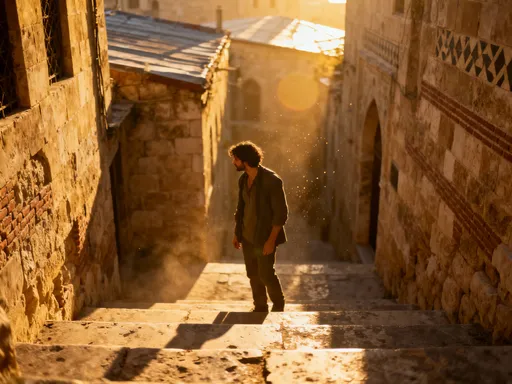
To truly experience Dijon’s hidden gems, a shift in pace and perspective is essential. Rather than rushing from one landmark to the next, consider adopting a slower, more intentional approach to exploration. Begin early in the morning, when the city wakes gently—bakers open their ovens, shopkeepers sweep their steps, and the streets are free of crowds. This is the ideal time to wander through quiet alleys and capture the soft light on centuries-old stone.
A suggested route might start at the Tour Philippe le Bon, where a climb to the top offers orientation and inspiration. From there, descend into the old town, following Rue des Forges toward the Cour du Parlement. Pause at open gateways, allowing yourself to notice details—a carved gargoyle, a weathered door knocker, a vine creeping up a courtyard wall. Continue to the Chapelle des Cordeliers, perhaps arriving in time for a midday concert or moment of quiet reflection.
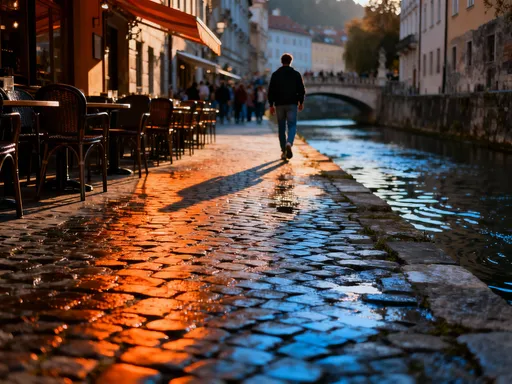
For lunch, step into Les Halles Fontaine, where regional specialties await. Choose a table at a small café nearby, savoring each bite while observing daily life unfold. In the afternoon, explore the passages couverts, then visit Le Consortium or Le FRAC for a dose of contemporary culture rooted in history. End the day with a walk along the quieter stretches of the Bourbince River, where willow trees dip into the water and the city’s skyline glows at sunset.
To navigate thoughtfully, use locally recommended maps or apps that highlight heritage sites beyond the mainstream. Respect private property—admire from the outside, photograph discreetly, and never enter restricted areas. Support small businesses by purchasing a coffee, a pastry, or a handmade gift from a local artisan. These small acts of mindfulness enrich the journey and contribute to the community you’re visiting.
The Quiet Majesty of Forgotten Corners
Dijon’s soul does not reside in its fame, but in its forgotten façades, silent courtyards, and the gentle hum of daily life in ancient streets. Its true grandeur is not shouted from billboards or crowded plazas, but whispered through weathered stone, iron gates, and the soft echo of footsteps in a hidden courtyard. To discover these places is to engage in a different kind of travel—one rooted in attention, respect, and quiet wonder.
Every city has such corners—spaces overlooked by guidebooks, undervalued by mass tourism, yet rich with meaning for those who take the time to look. Dijon reminds us that authenticity is not found in perfection, but in the layers of time, in the marks left by generations who lived, worked, and believed in the beauty of their surroundings. The city’s hidden landmarks are not just architectural feats; they are testaments to resilience, craftsmanship, and the enduring human desire to create spaces of dignity and grace.
As travelers, we have a choice: to skim the surface or to look deeper. To seek not just the famous, but the meaningful. Dijon, with its mustard-yellow alleys and shadowed arcades, invites us to slow down, to wander with purpose, and to find beauty in the overlooked. And in doing so, we do not just see a city—we begin to understand it. May your journeys, wherever they lead, be filled with such quiet discoveries, where the past speaks softly, and the heart listens closely.